Advantages of fast photo editing for real estate pros
Advantages of fast photo editing for real estate pros

Real estate professionals and interior designers face a constant challenge: delivering stunning property photos fast enough to capture buyer interest before the moment passes. Traditional editing workflows can take days, causing delays that cost opportunities. Fast photo editing solutions promise to solve this problem, but choosing the right approach means understanding how to balance speed with quality. This guide explores the key criteria for evaluating fast photo editing tools, reveals the top advantages AI-driven solutions deliver, and helps you determine which method fits your specific real estate and design visualization needs.
Table of Contents
- Key takeaways
- Criteria to evaluate fast photo editing solutions
- Top advantages of AI-driven fast photo editing
- Limitations and quality considerations of fast photo editing
- Comparing fast photo editing options for your needs
- Explore fast photo editing solutions with VibeMyFlat
- FAQ
Key Takeaways
| Point | Details |
|---|---|
| Rapid turnaround advantage | Fast editing dramatically reduces listing time and accelerates marketing cycles. |
| AI cuts processing time | AI driven tools cut costs and reduce manual effort while maintaining professional quality. |
| Hybrid balance speed | Hybrid approaches use AI for speed and expert review for accuracy. |
| Test challenging images | Test solutions with challenging images to avoid quality issues that harm buyer trust. |
Criteria to evaluate fast photo editing solutions
Selecting the right fast photo editing solution requires examining several critical factors that directly impact your marketing success and client satisfaction. Speed alone doesn’t guarantee results if the final images fail to showcase properties effectively.
Turnaround time stands as the primary consideration. Your editing solution must process images fast enough to meet tight listing deadlines and capitalize on market opportunities. Real estate markets move quickly, and delays of even a few hours can mean losing interested buyers to competing properties. Solutions that deliver edits within minutes rather than days provide a decisive competitive advantage.
Image quality and detail accuracy separate amateur results from professional presentations. Fast editing means nothing if the output contains obvious distortions, unnatural lighting, or texture mismatches that alert viewers to artificial manipulation. Buyers scrutinize property photos carefully, and quality issues erode trust instantly. Your chosen solution must preserve architectural integrity while enhancing visual appeal.
Cost and scalability determine whether a solution fits your business model. High-volume agents and design firms need per-image costs low enough to edit dozens or hundreds of photos monthly without breaking budgets. Scalability ensures the solution handles peak workloads during busy seasons without performance degradation or price spikes.
Error handling capabilities matter significantly for complex editing scenarios. Homeowners staging houses with AI face challenges when pure AI struggles with nuanced texture matching or perspective corrections. Solutions that combine AI speed with manual oversight for difficult cases deliver more consistent results across diverse property types and lighting conditions.
Hybrid models represent the optimal balance for professionals who demand both speed and reliability. These approaches use AI for initial processing to achieve rapid turnaround, then apply expert review to catch and correct errors before delivery. This combination addresses the speed versus quality tension that pure AI or manual-only workflows cannot resolve alone.
Pro Tip: Test any fast editing solution with your most challenging property photos before committing. Images with complex lighting, reflective surfaces, or intricate architectural details reveal whether the tool can handle real-world conditions beyond simple room shots.
Understanding rapid photo editing AI for real estate helps you set realistic expectations and choose solutions that align with your quality standards and business requirements.
Top advantages of AI-driven fast photo editing
AI-powered photo editing delivers transformative benefits that reshape how real estate professionals and designers manage visual content production and property marketing timelines.
Speed represents the most obvious advantage. Technical benchmarks show services achieving 28-second median latency with 99.9% uptime, enabling professionals to process entire property shoots within minutes rather than waiting days for traditional editing. This acceleration means listing photos can go live the same day as the shoot, capturing buyer interest while properties are fresh on the market.
Cost efficiency makes high-volume editing economically viable. At $0.008 per image at scale, AI solutions allow agents to edit every photo from a shoot without worrying about budget constraints. This pricing model transforms editing from a selective process where only the best shots get enhanced into a comprehensive workflow where every angle receives professional treatment.
Time savings extend beyond raw processing speed. AI editing eliminates the back-and-forth communication typical of outsourced manual editing, where revision requests and clarifications add days to turnaround. Professionals using AI tools report 87% time savings compared to traditional workflows, freeing hours for client consultations, property showings, and business development activities that directly generate revenue.

Ease of use democratizes professional editing capabilities. User-friendly photo editing platforms let homeowners and junior team members produce quality results without extensive training or technical expertise. Natural language interfaces allow users to describe desired changes in plain English rather than learning complex software tools, lowering barriers to entry and expanding who can contribute to visual content creation.
Consistent availability ensures editing capacity when you need it. Unlike human editors who work business hours and take time off, AI services operate 24/7 with high uptime guarantees. This reliability proves invaluable during peak seasons or when last-minute listing opportunities require immediate turnaround.
“AI-driven editing doesn’t just make us faster. It fundamentally changes our capacity to serve more clients simultaneously without sacrificing quality or burning out our team.” — Real estate team leader
Reduced manual drudgery improves job satisfaction for professionals who previously spent hours on repetitive editing tasks. Automating tedious adjustments like exposure correction, color balancing, and basic retouching lets creative professionals focus on higher-value activities that leverage their expertise and judgment.
Pro Tip: Establish standard editing presets for different property types in your AI tool. Consistent styling across your listings builds brand recognition and streamlines your workflow by reducing decision-making time for routine edits.
Limitations and quality considerations of fast photo editing
While AI-driven fast photo editing delivers impressive speed and efficiency, understanding its limitations helps you avoid quality pitfalls that can undermine property presentations and damage professional credibility.
AI struggles with several technical challenges that affect output quality. Texture mismatches occur when AI attempts to replace or modify surfaces, creating unrealistic patterns that don’t match the original material properties. Perspective distortions happen when AI misinterprets spatial relationships, causing walls to appear warped or furniture to look disproportionate. These errors become immediately obvious to viewers and signal artificial manipulation.
Complex object removal presents another significant challenge. AI tools may successfully remove simple items like small furniture pieces, but struggle with intricate scenarios involving shadows, reflections, or overlapping objects. The result often shows telltale artifacts, ghosting, or unnatural blending that reveals the manipulation.
Low-light images expose AI limitations dramatically. Photos taken in dim conditions or with challenging lighting ratios push AI algorithms beyond their training data, producing results with excessive noise, color shifts, or loss of fine detail. Properties photographed in less-than-ideal conditions require more sophisticated processing than pure AI currently delivers reliably.
Architectural integrity risks emerge when AI makes unauthorized changes to structural elements. Some aggressive AI tools may subtly alter room dimensions, ceiling heights, or window proportions in pursuit of aesthetic improvements. These modifications misrepresent properties and create legal exposure if buyers discover discrepancies during showings.
Artificial appearance remains a persistent issue. AI-processed images sometimes exhibit an overly smooth, plastic quality that lacks the natural texture and subtle imperfections of authentic photography. This artificial look triggers skepticism in sophisticated buyers who recognize digitally manipulated imagery.
“The biggest risk with pure AI editing isn’t obvious failures. It’s the subtle wrongness that makes buyers question whether anything in the listing is real.” — Interior design photographer
Hybrid workflows mitigate these limitations by combining AI speed with human oversight. Expert editors review AI output, catching errors before delivery and applying manual corrections where AI falls short. This approach preserves fast turnaround for straightforward edits while ensuring quality control for challenging images.
Color accuracy issues affect how properties appear across different devices and lighting conditions. AI may optimize images for screen viewing without considering how colors translate to print materials or appear under various ambient lighting, creating inconsistencies across marketing channels.
Understanding these limitations doesn’t mean avoiding AI editing. Rather, it means choosing appropriate applications, setting quality checkpoints, and maintaining seamless photo editing practices that balance efficiency with standards.
Comparing fast photo editing options for your needs
Real estate professionals and designers face three primary approaches to fast photo editing, each offering distinct advantages and tradeoffs that suit different business models and quality requirements.
| Method | Speed | Quality | Cost | Best For |
|---|---|---|---|---|
| Pure AI | Fastest (under 30 sec) | Good for standard scenes | Lowest ($0.008/image) | High-volume agents, basic enhancements |
| Manual editing | Slowest (hours to days) | Highest precision | Highest ($5-15/image) | Luxury properties, complex scenes |
| Hybrid AI + manual | Fast (minutes) | Excellent balance | Moderate ($1-3/image) | Professional firms, quality-focused brands |
Pure AI editing delivers unmatched speed and cost efficiency for professionals processing large volumes of straightforward property photos. This approach works best when images have good lighting, simple compositions, and require standard enhancements like exposure correction, color balancing, and basic retouching. The low per-image cost makes it economical to edit every photo from a shoot, ensuring comprehensive visual coverage without budget concerns.
However, pure AI editing carries quality risks when handling nuanced scenes with complex lighting, reflective surfaces, or intricate architectural details. Errors in these situations can undermine property presentations and require time-consuming rework that negates the initial speed advantage.
Manual editing by experienced professionals ensures the highest accuracy and attention to detail. Expert editors handle challenging scenarios that confuse AI algorithms, preserving architectural integrity while achieving sophisticated aesthetic enhancements. This approach suits luxury properties where image quality directly impacts perceived value and buyer expectations demand perfection.
The primary drawback of manual editing is speed. Turnaround times measured in days rather than minutes create bottlenecks that delay listings and reduce marketing agility. Higher costs also limit how many images receive professional treatment, forcing selective editing that may leave some property angles under-optimized.
Hybrid approaches blend AI automation with expert oversight to deliver balanced results that satisfy both speed and quality requirements. These workflows use AI for initial processing to achieve rapid turnaround, then route images through quality checkpoints where editors review output and apply manual corrections as needed.
Selecting your ideal method requires honest assessment of your priorities:
- Define your quality threshold by examining your target market and competition. Luxury properties demand higher standards than entry-level rentals.
- Calculate your volume requirements based on typical shoots and listing frequency. High volumes favor AI automation.
- Evaluate your budget constraints to determine sustainable per-image costs across your expected editing volume.
- Consider your timeline sensitivity and how quickly you need edited images to capitalize on market opportunities.
- Assess your team’s technical capabilities and whether you have expertise to review and correct AI output when necessary.
Many successful professionals adopt a tiered approach, using pure AI for routine listings, hybrid workflows for mid-range properties, and manual editing for premium offerings. This strategy optimizes both efficiency and quality across diverse inventory.
Exploring natural language photo editing AI helps you understand how modern tools simplify the editing process regardless of which method you choose.
Explore fast photo editing solutions with VibeMyFlat
Now that you understand the advantages and considerations of fast photo editing, you’re ready to experience how AI-powered solutions can transform your property marketing and design visualization workflows. VibeMyFlat delivers professional-quality edits in under 30 seconds using natural language commands that eliminate technical complexity.
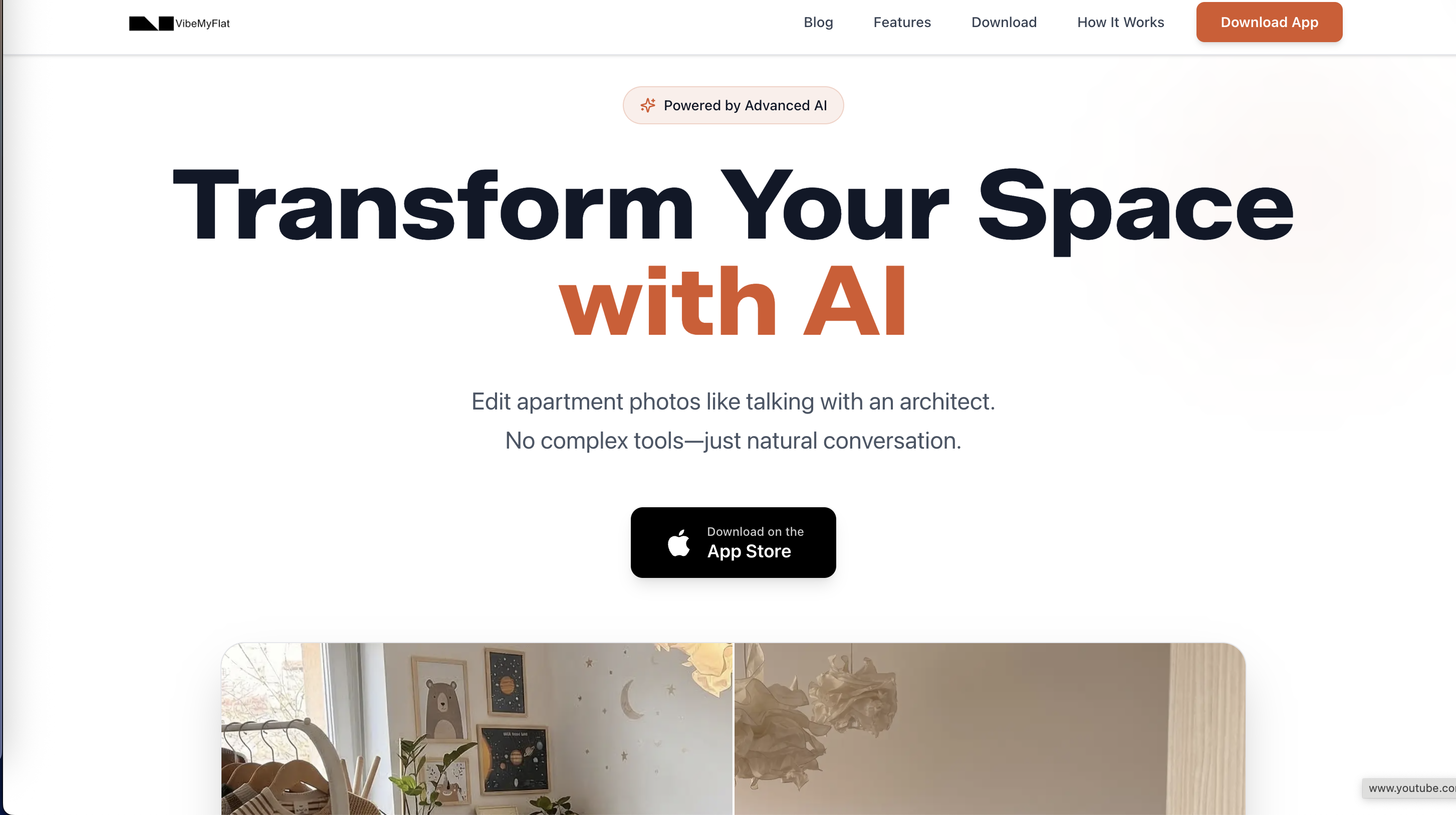
Designed specifically for real estate professionals, interior designers, and homeowners, VibeMyFlat’s AI photo editor combines the speed of pure AI with intelligent processing that understands design principles and architectural context. Whether you’re refreshing listing photos, visualizing renovation concepts, or exploring design alternatives, the platform provides the efficiency you need without sacrificing the quality your clients expect. Discover how rapid photo editing AI for real estate can accelerate your business today.
FAQ
What are the main advantages of fast photo editing for real estate?
Fast photo editing dramatically shortens the time between property shoots and listing launches, allowing agents to capture buyer interest while properties are fresh on the market. This speed advantage helps maintain competitive positioning and enables rapid response to market feedback. Additionally, quick turnaround supports agile marketing strategies where you can test different visual presentations and refine based on engagement metrics.
How does AI impact the quality of fast photo edits?
AI accelerates editing workflows significantly but can introduce quality issues in challenging scenarios. AI struggles with texture mismatches, perspective distortions, and complex object removal, particularly in low-light images where algorithms lack sufficient training data. These limitations mean pure AI works best for straightforward enhancements on well-lit photos. Hybrid editing approaches that combine AI speed with expert review help balance rapid turnaround with quality assurance.
What type of photo editing method is best for quick property listings?
Pure AI editing offers the fastest turnaround for standard property photos with good lighting and simple compositions, making it ideal for high-volume agents who need same-day listing launches. Manual editing suits properties where image quality directly impacts perceived value and buyer expectations demand perfection, though slower turnaround limits marketing agility. Hybrid approaches are optimal for professionals who need to balance speed with consistent quality across diverse property types and lighting conditions.
How much does fast photo editing typically cost?
Costs vary significantly by method and provider. Pure AI editing services can process images for as low as $0.008 per photo at scale, making high-volume editing economically viable. Manual editing by professional retouchers typically ranges from $5 to $15 per image depending on complexity and turnaround requirements. Hybrid services that combine AI automation with expert review generally fall in the $1 to $3 per image range, offering a middle ground between pure speed and pure quality.
Can fast photo editing handle complex architectural photography?
Fast AI editing performs well on straightforward architectural shots with good lighting and clear compositions, handling standard enhancements like exposure correction and color balancing reliably. However, complex scenarios involving intricate details, challenging lighting ratios, or sophisticated perspective corrections often exceed pure AI capabilities. Properties with unique architectural features, reflective surfaces, or dramatic lighting benefit from hybrid workflows where AI provides initial processing speed and human editors refine nuanced elements that require professional judgment.