How AI Transforms Property Photos for Real Estate Pros
How AI Transforms Property Photos for Real Estate Pros

TL;DR:
- AI-powered photo editing tools now deliver professional-quality property images in seconds at lower costs. Visuals significantly impact buyer interest, with AI enhancing speed, scale, and compliance for real estate marketing. Ethical use requires transparent disclosure of digital edits to maintain trust and meet legal standards.
Most real estate professionals still believe that stunning property photos require either an expensive photographer or hours of manual retouching. That assumption is losing ground fast. AI-powered photo editing tools are now delivering professional-quality results in under 30 seconds, at a fraction of the traditional cost, and at a scale that no human editor can match alone. Whether you manage dozens of listings or design high-end interiors, understanding how AI fits into your visual workflow is no longer optional. This guide breaks down what AI tools actually do, how to choose the right one, and how to use them without crossing ethical lines.
Table of Contents
- Why property visuals matter more than ever
- How AI photo tools transform property images
- Choosing the right AI tools for property photos
- Best practices for ethical and effective AI photo editing
- A new era in property marketing: Lessons from AI adoption
- Transform your property photos with next-generation AI tools
- Frequently asked questions
Key Takeaways
| Point | Details |
|---|---|
| AI photo editing boosts speed | AI tools transform dozens of property images in seconds, saving hours over manual editing. |
| Virtual staging delivers high ROI | Digitally staged photos can achieve 200–600 times the return on investment compared to physical staging. |
| Choose real estate-specific tools | Platforms like Roomagen, Imagen, and Fotello provide MLS-compliance, batch edits, and before/after image pairs. |
| Stay transparent | Always disclose AI alterations in property photos to maintain trust and meet industry standards. |
Why property visuals matter more than ever
Property photos are not just marketing materials. They are the first handshake between a listing and a potential buyer or renter. In a market where most searches begin online, a weak photo set can kill interest before a single conversation happens. Strong visuals drive faster sales, higher offers, and more foot traffic to open houses.
Here is what the data tells us about buyer behavior:
- Listings with professional photos sell 32% faster than those without
- Buyers spend more than 60% of their time looking at photos before reading the listing description
- Poor lighting or cluttered images are among the top reasons buyers skip a listing entirely
- Virtual staging has become a baseline expectation for many online buyers in competitive markets
“A buyer’s first impression of a property is almost always visual. If the photo does not create an emotional connection in the first few seconds, the listing loses.”
Physical staging is one traditional solution, but it is expensive, slow, and logistically complicated. Coordinating furniture rentals, movers, and photographers for every listing is not scalable. That is where digital and AI-driven edits come in.
Virtual staging ROI runs 200 to 600 times higher than physical staging, but it requires disclosure to avoid misrepresentation. That ROI gap is enormous, and it explains why so many agents and designers are shifting their workflows toward digital-first approaches.
Understanding why pro photo editing boosts sales is the first step. The second is recognizing that fast photo editing advantages now extend well beyond simple color correction. AI has expanded the toolkit dramatically, and buyer expectations have followed.
Transparency remains non-negotiable. Disclosing AI or virtual edits is not just an ethical practice. It is increasingly a legal and MLS requirement. Professionals who skip disclosure risk complaints, fines, and damaged reputations.
How AI photo tools transform property images
AI photo editors are not just faster versions of Photoshop. They use machine learning models trained on millions of interior and architectural images to understand context, lighting, perspective, and design principles. That means they can make decisions, not just execute commands.

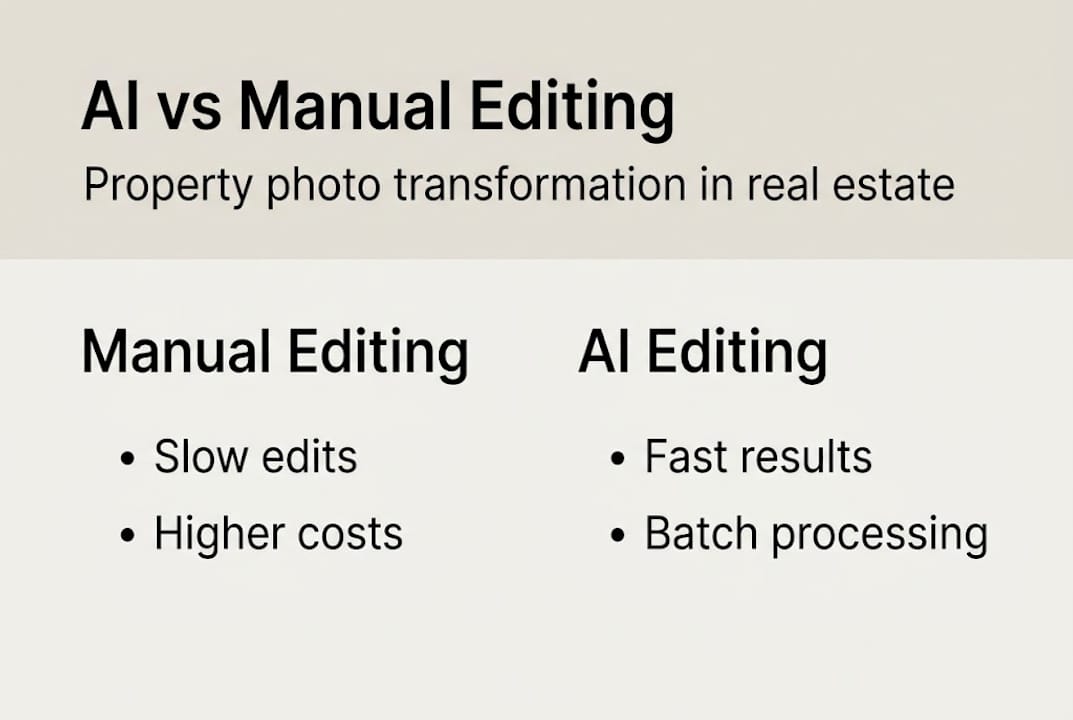
Here is a comparison of AI editing versus traditional manual retouching:
| Task | Traditional editing | AI editing |
|---|---|---|
| Color correction | 15 to 30 minutes | Under 10 seconds |
| Virtual staging | 2 to 4 hours | 30 to 60 seconds |
| Object removal | 20 to 45 minutes | Under 15 seconds |
| Batch processing (10 images) | Half a day | Minutes |
| Cost per image | $20 to $80 | $1 to $5 |
The speed and cost difference is not marginal. It is transformational for anyone managing multiple listings.
Here is what modern AI photo tools can handle for property images:
- Automated color correction and white balance to make spaces look bright and inviting
- Virtual furniture staging that fills empty rooms with realistic, style-matched furniture
- Sky replacement to turn a gray exterior shot into a bright, sunny day
- Object and clutter removal without leaving artifacts or blurry patches
- Lighting enhancement to balance shadows and highlights in challenging interiors
Pro Tip: Run a small batch test before committing to any AI platform. Use five to ten of your most challenging listing photos, including tight spaces and unusual lighting, to see how the tool handles edge cases.
For a deeper look at how these tools work in practice, AI rapid photo editing insights and quick AI editing steps are worth reviewing before you choose a platform.
That said, AI excels in speed, cost, and scale versus traditional human editing, but humans still outperform AI on luxury properties, complex architectural details, and situations where authentic storytelling matters most. Know your use case before automating everything.
Choosing the right AI tools for property photos
Not every AI photo editor is built for real estate. General-purpose tools may produce decent results but often miss the specific requirements of MLS submissions, listing platforms, and compliance standards. Choosing the wrong tool wastes time and can create compliance headaches.
Here is a side-by-side look at key evaluation criteria:
| Feature | Why it matters |
|---|---|
| MLS-compliant output | Required for listing submissions on most platforms |
| Before/after image pairs | Essential for transparency and marketing materials |
| Batch processing | Saves hours when handling multiple listings |
| Virtual staging presets | Speeds up room design without custom work |
| User-friendly interface | Reduces learning curve for non-technical users |
| Processing speed | Determines workflow efficiency at scale |
When evaluating platforms, prioritize tools like Roomagen, Imagen, and Fotello for real estate-specific AI, focusing on MLS-compliant outputs with before/after pairs. These platforms are built with listing workflows in mind, not general photo editing.
Key features to look for when making your choice:
- Output resolution that meets MLS and print standards
- Staging style libraries that match your target buyer demographic
- Transparent pricing with per-image or subscription options
- Customer support familiar with real estate workflows
- Integration options with your existing CRM or listing tools
Pro Tip: Always request a free trial or demo account before purchasing. Run the tool on your actual listing photos, not the platform’s sample images. Real-world performance is what matters.
For practical guidance on building an efficient process, AI workflow tips and AI photo enhancement options offer solid frameworks for getting started without overcomplicating your setup.
Best practices for ethical and effective AI photo editing
AI can make a vacant studio look like a furnished showroom in under a minute. That power comes with real responsibility. Misrepresenting a property through undisclosed digital edits is not just an ethical problem. It can expose you to legal liability and damage trust with buyers, renters, and colleagues.
Here are the core ethical practices every real estate and design professional should follow:
- Disclose all AI and virtual edits in the listing description, photo captions, or both
- Keep original, unedited images on file as proof of the property’s actual condition
- Never remove structural elements like walls, windows, or permanent fixtures in edited images
- Comply with local MLS rules and advertising standards, which vary by region
- Update your disclosure practices as AI guidelines in real estate continue to evolve
“The goal of AI editing is to present a property at its best, not to create a fantasy version that disappoints buyers on viewing day.”
Virtual staging offers high ROI but requires disclosure to avoid misrepresentation. The professionals who build long-term reputations are the ones who use AI to enhance reality, not replace it.
For more on the broader value of transparent AI use, AI visualization benefits explains how honest digital enhancements can actually build buyer trust rather than erode it. And user-friendly editing tips can help you maintain quality without sacrificing speed or compliance.
Staying current matters. Industry bodies and MLS organizations are actively developing clearer AI guidelines, and what is acceptable today may have stricter requirements by next year. Build disclosure and compliance review into your standard workflow now.
A new era in property marketing: Lessons from AI adoption
Here is something the enthusiasm around AI tools often glosses over: speed alone does not create compelling property marketing. We have seen agents automate their entire photo workflow and end up with technically clean but emotionally flat images. Every room looks staged the same way. Every listing feels interchangeable. That is not a win.
The professionals getting the best results from AI are not the ones automating everything. They are the ones using AI to handle the repetitive, time-consuming tasks, and then applying human judgment at the end. They review outputs. They adjust staging choices to match the property’s story and target buyer. They make sure the final image feels authentic, not algorithmic.
AI delivers genuine value when it is paired with strategy and storytelling. A vacant condo in a urban neighborhood needs different staging choices than a family home in the suburbs. AI can execute both quickly, but a human still needs to make the call on which direction to take. Reviewing quality editing steps can help you build that human review layer into your process without slowing things down.
The future of property marketing is not AI versus humans. It is AI plus human oversight, used intentionally.
Transform your property photos with next-generation AI tools
Everything covered in this guide points to one practical conclusion: AI photo editing is now a core skill for competitive real estate professionals and interior designers. The tools are fast, affordable, and capable of delivering results that would have required a full production team just a few years ago.

VibeMyFlat is built specifically for this workflow. You can describe the changes you want in plain language, like “brighten the living room and add a modern sofa,” and the platform delivers professional results in under 30 seconds. It works across web, iOS, and Android, so your editing workflow goes wherever your listings do. If you are ready to move faster without sacrificing quality or compliance, explore what the VibeMyFlat AI Photo Editor can do for your next listing.
Frequently asked questions
Is AI property photo editing allowed by real estate regulations?
AI editing is permitted as long as changes are disclosed and images comply with MLS and advertising guidelines. Virtual staging requires disclosure to avoid misrepresentation under most regional standards.
How fast can AI photo tools work compared to manual retouching?
AI tools can apply edits in seconds, while manual editing may take hours for comparable results. AI excels in speed and scale across batch processing tasks that would overwhelm a single human editor.
What AI tool features should real estate pros prioritize?
Top features include MLS-compliant output, automated before/after images, batch processing, and ease of use. Tools like Roomagen, Imagen, and Fotello are purpose-built for real estate-specific requirements.
Can AI staging mislead buyers or renters?
If not disclosed, AI and virtual staging may create false expectations about a property’s actual condition. Always inform viewers of digital alterations to maintain trust and meet legal requirements.